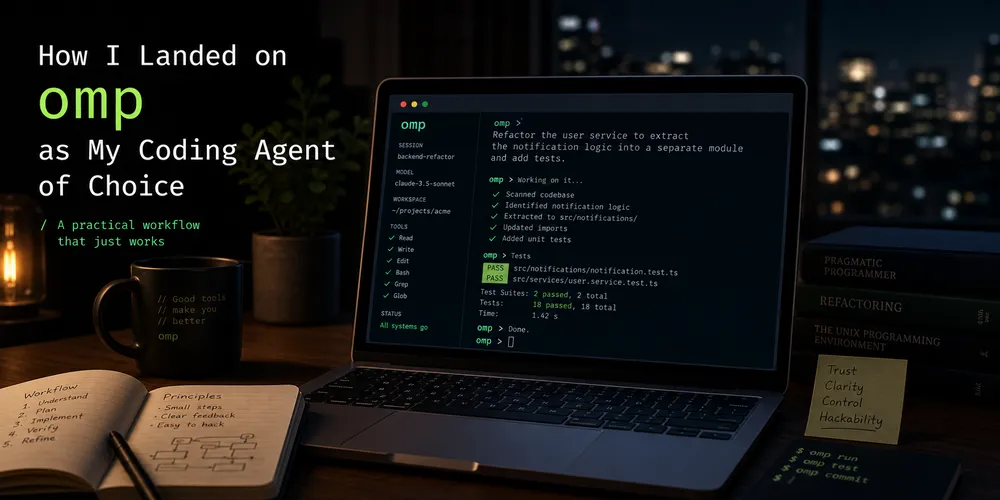
Over the last year I've tried many coding agents so I'm documenting the journey here. This isn't a careful benchmark where every tool got the same prompt and a score. This is mostly just vibes.
There are desktop versions of some of these apps but I'm only considering the terminal versions. I've lived in the terminal for most of my career. I've used Vim forever, and I still prefer tools that work there because they all integrate well with eachother and my muscle memory never translated to Sublime Text or VSCode despite my honest efforts.
Right now, the best agent for me is omp, so here's how I got there.
Warp: a great introduction
Warp was my introduction to coding agents. It moved seamlessly between being a command line and being an agent, and it figured out which model to use without making me think about it. That was a great way to get started. I could stay in one tool and gradually learn when to type a command myself and when to hand the problem to an agent.
Later updates separated those two modes more clearly. I'm sure that made sense as a product decision, but I had trouble adopting the new workflow. The muscle memory I'd built was gone. Bummer.
OpenCode: almost the one
I really liked OpenCode. I was back in a regular terminal and no longer mistaking if I should be typing commands or prompts. Then I realized how great Opus was and how much money I could save by using it through a Claude subscription instead of paying API rates.
I tried a few hacks to use my Claude plan with OpenCode, but none of them worked out reliably. The subscription math won, so I moved on—not because I disliked OpenCode, but because the cost difference was too large to ignore.
Claude Code: the great compromise
I resigned myself to learning Claude Code. The savings on the $100 plan were undeniable, and the agent was good enough that the new interface felt worth learning.
I was impressed enough with Fable that I upgraded to the $200 plan. Then Fable was pulled the next day, and that extra $100 was basically wasted for me that month. That was the last time I paid for a Claude subscription.
Oh yeah, and one of the most annoying features ever is it's insistence on tagging every commit message with Co-Authored by: Claude Opus... yak.
Pi: the appeal of a hackable agent
Then I found Pi. It promised to be a minimal coding agent for hackers, including the ability to modify itself. That immediately made sense to me. I was inspired to try it after watching this "love letter to Pi" YouTube video.
It delivered. I could fix the little issues that bothered me in other agents. For example, I wanted tab completion for file paths that weren't tracked in Git. Instead of changing my workflow, I could make the agent behave the way I wanted.
omp: where I've landed
I first saw omp in the list of agents supported by Herdr and thought, interesting. I tried it, kept using it, and haven't had a reason to leave.
It combines the solid, hackable core with great themes and UX. It shows me the information I need to understand instead of hiding what it's doing and distracting me with nonsense words.
After a year of moving between agents, that's enough to make omp my coding agent of choice.